
































Cuffing season is the fall-and-winter period when some single people seek a romantic partner, often for short-term companionship through the colder months. It usually refers to roughly October through February or March in U.S. dating culture. The dates are informal, and a relationship that starts then can last much longer.
If someone mentions wanting a “cuffing season partner,” the useful follow-up is what that means to them. Are they looking for company over the holidays, an exclusive relationship, or something they hope will continue? A shared blanket tells you less than their answer.
Why is it called cuffing season?
The “cuff” refers to handcuffs as a metaphor for being attached to someone. It is dating slang, not a reference to literal restraint. Merriam-Webster’s dictionary entry traces the romantic use of “cuffing” to African American English, later popularized through rap and hip-hop.
Being “cuffed” generally means being coupled up. It does not, by itself, tell you what either person has agreed to. Exclusivity, commitment, and how long you want to date still need a conversation.
When is cuffing season?
Cuffing season generally covers fall through late winter or early spring. October is a common starting point, while Valentine’s Day in February often marks the season’s symbolic finale. Some descriptions extend it into March.
Treat those months as context rather than a schedule. There is no official deadline to find a partner, become exclusive, or break up. The fall-and-winter framing also reflects Northern Hemisphere seasons; the same months are not cold everywhere.
Search interest shows why the term resurfaces each fall. In the U.S. Google Trends comparison below, interest in “cuffing season” rose sharply in September 2026 and remained above summer levels in early November. That measures searches for the phrase, not how many people started relationships.
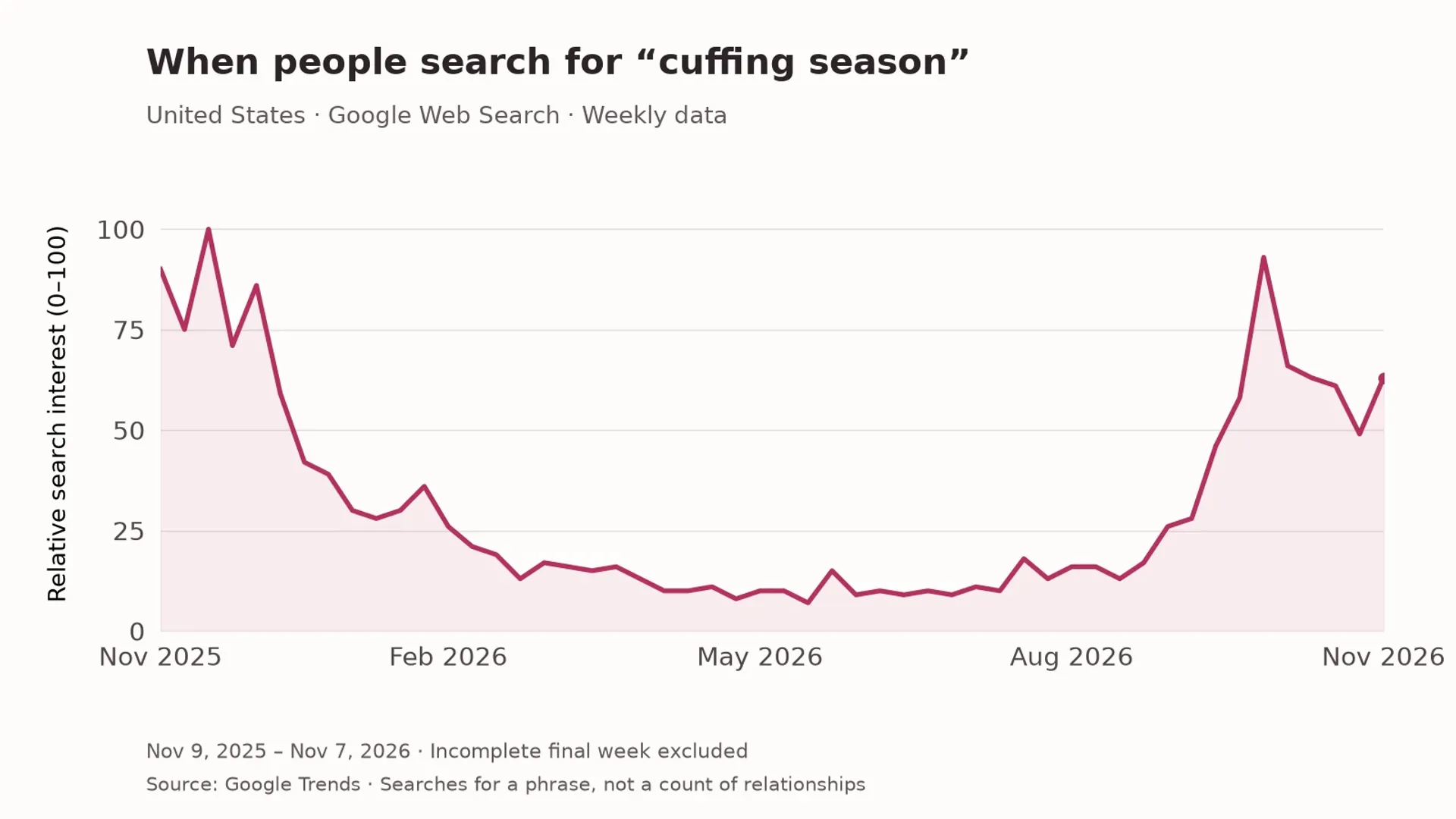
U.S. Web Search interest, weeks beginning November 9, 2025 through November 1, 2026. The 0–100 index is relative to the peak in the saved comparison. Source: Google Trends. The incomplete final week was excluded.
Why might you want a partner more in winter?
The appeal can be practical: someone to share quiet evenings with, a date for holiday gatherings, or a familiar person to make weekend plans with. If more of your social life has moved indoors, regular company may sound especially good.
Before pursuing a relationship, ask yourself: “Would I still want to spend time with this person if holiday plans weren’t part of it?” You can enjoy their company and want comfort at the same time. The point is to understand what you are offering before asking someone else to get involved.
Does cuffing season mean casual dating or a serious relationship?
The term often suggests a temporary relationship, but people use it loosely. Someone might mean a winter fling. Someone else might simply be dating more actively and hoping to find a lasting partner.
Three separate questions matter:
- Timing: Why are you interested in dating now?
- Exclusivity: Are you agreeing to date only each other?
- Intentions: Are you hoping for something temporary, ongoing, or still undecided?
A relationship can be exclusive without a shared plan for the future. Two people can also be interested in a serious relationship while still getting to know each other. Holiday invitations, frequent messages, and staying over do not settle those questions automatically.
Wanting companionship is a reasonable reason to date. Wanting something casual can be reasonable too, when both people understand and want that arrangement. The problem is leaving someone to make decisions based on an expectation you know you do not share.
Three conversations to have with a cuffing season partner
Our advice is to ask about intentions, exclusivity, and future expectations separately. That makes it easier to hear a specific answer instead of treating “let’s see where it goes” as a promise.
The examples below are suggested wording you can adapt. Choose the version that reflects what you actually want.
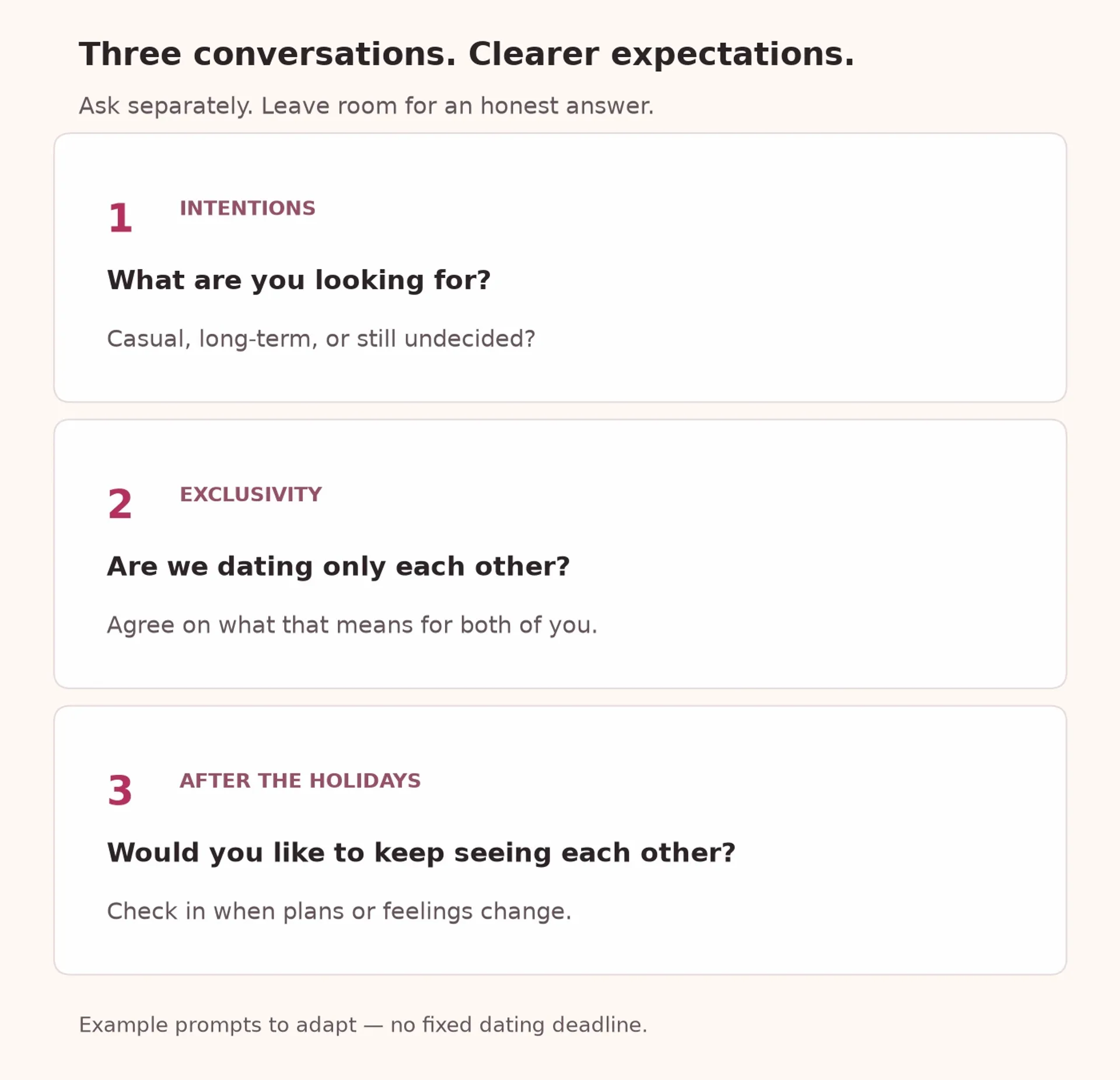
1. Say what you are looking for
If you want a lasting relationship:
“I’m enjoying getting to know you. I’m dating with the hope of finding a long-term relationship. What are you looking for right now?”
If you want something casual:
“I’d like to keep seeing you, but I’m not looking for a committed relationship. Would something casual work for you?”
You do not need a fixed date number for this conversation. Bring it up when the answer would affect your choice to keep dating or become more involved. You can ask what someone wants without asking them to promise that you will be together forever.
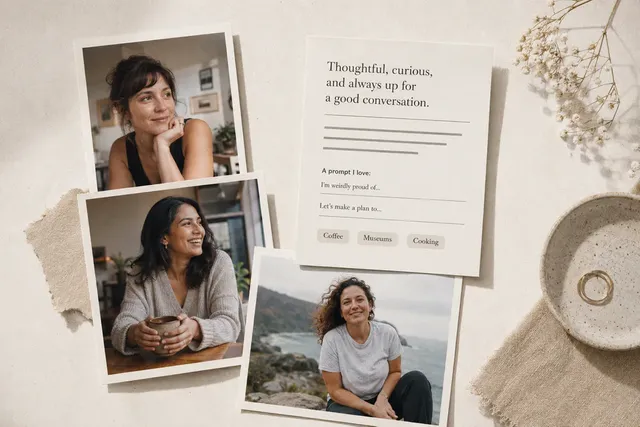
If your profile leaves your intentions unclear, the WooPlus dating profile template includes a place to put them into words. A profile can start the conversation; it does not replace it.
2. Ask directly about exclusivity
Seeing each other every weekend can feel like a relationship before you have agreed on one. Try:
“I’d like to date exclusively. Is that something you want too, and what would it mean for us?”
Discuss what you each mean, including dating-app use and seeing other people. If physical intimacy is part of your connection, discuss your comfort levels and safer-sex expectations before making assumptions.
The relationship resource love is respect explains why boundaries and expectations need to be communicated: an expectation one person assumes is not necessarily an agreement the other person has made.
3. Check in when plans or feelings change
You might start casually and later want more. Or the holiday period might be ending, leaving you unsure whether your connection fits everyday life. A check-in can be simple:
“I’ve really liked spending this time with you. I’d like to keep seeing you after the holidays. How are you feeling about us?”
Then listen to the answer as it stands. “I’m not sure” leaves uncertainty; it does not guarantee a future yes. You can decide how much uncertainty works for you without trying to persuade the other person into a different relationship.
| What you both say you want | A useful next step |
|---|---|
| You both want something casual | Agree on boundaries and speak up if feelings change. |
| You both want to explore a lasting relationship | Make room for ordinary dates and consistent contact beyond holiday events. |
| One wants commitment and the other wants something temporary | Decide whether continuing would meet your needs, rather than relying on a change of heart. |
| One or both are unsure | Discuss what is clear now and when you would like to check in again. |
How can you tell whether the interest is genuine?
The month you met cannot answer that. Neither can one canceled date or an evening spent watching movies at home. Pay attention to patterns and to how the person responds when you express a preference.
Do they follow through on plans? Ask about your life? Make room for the kinds of dates you enjoy? Respect a no without pressure? Can you talk about what you want without being mocked or brushed off?
These questions help you assess whether the arrangement works for you. They cannot prove someone’s private motives or predict how long a relationship will last.
For plus-size daters: privacy and secrecy deserve a closer conversation
If you are a plus-size dater who is repeatedly invited over but never taken on the dates you suggest, you may wonder whether the other person is comfortable being seen with you.
Home dates can be enjoyable, and keeping a new relationship off social media can be a shared preference. You do not need a public post or an immediate introduction to someone’s family to make a connection valid. But you can still want dates outside the house and a relationship that does not require hiding.
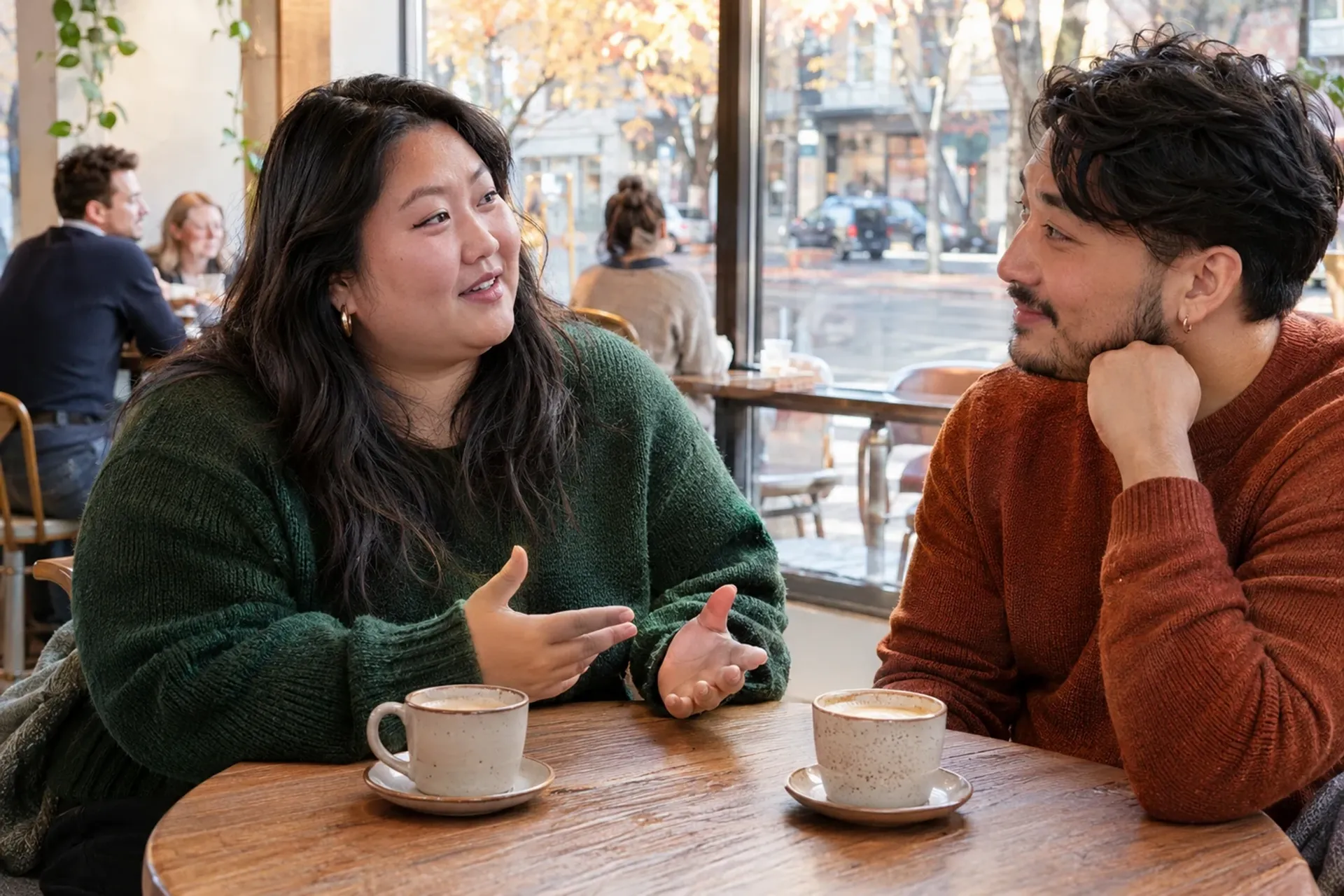
AI-generated illustration of a public cafe date; not a WooPlus member story.
Try a concrete invitation:
“I like spending time together at home, and I’d also like to go out. Would you be up for coffee on Saturday afternoon?”
We would focus on their response to that reasonable request. Suggesting another day or an accessible, affordable alternative is different from repeatedly dismissing what you want or making degrading comments about your body.
You do not have to prove that someone is “using you for winter” before deciding that the situation is not enough for you. If body-related comments are part of the problem, WooPlus’s guide to handling body shaming on dating apps covers options for setting boundaries and ending unwanted contact.
Can a cuffing season relationship last beyond winter?
Yes. Meeting in October does not give a relationship an expiration date. What matters is whether both people want to continue, and whether the connection works outside the circumstances that brought them together.
An ordinary afternoon together can tell you something different from a holiday party. So can making plans after a busy festive period, managing a disagreement respectfully, or finding a routine that suits you both. None guarantees a lasting relationship, but each gives you more to go on than a seasonal label.
If someone clearly says they only want a temporary relationship, take that seriously. You can enjoy it if it suits you, or step away if it does not.
You can also choose to stay single
Cuffing season is not an obligation. You can want company on a cold evening and still prefer being single. Make the dinner reservation with a friend, plan something you enjoy, or take a break from dating if that is what you want.
If you do want to meet someone, explore WooPlus to connect with other singles in a community centered on curvy dating. Start with what you are looking for, then give the other person room to answer honestly. The next step is finding out whether you want the same kind of connection.